Kingdom Rush is a tower defense game, and that phrase only means something once you have seen one. This page explains the whole thing from zero: what you are actually doing, how to click, what each tower does, and what to do on your very first stage. It is written to be read once before you start playing.
What Kingdom Rush is
You are a general defending a road. That is the entire fiction. An enemy army marches in from the edge of the map and walks a fixed, unchangeable road toward your gate. They do not attack your towers, they do not go around them, and they do not improvise. They walk the path, over and over, until they reach the end of it.
You stop them by building towers on marked build spots. Those grey circles on the map are the only places a tower can go. A tower on a build spot shoots at enemies as they pass by. Enemies walk the road, towers shoot the road, and somewhere in that exchange lives are lost. You start each stage with 20 lives, and every enemy that reaches your gate costs you one. When you run out of lives, the run is over.
You earn gold from defeating enemies and from the bonus for calling a wave early. Gold pays for new towers and upgrades. The basic loop is to place towers, defeat a wave, read the next threat, and spend what you earn before enemies reach the exit.
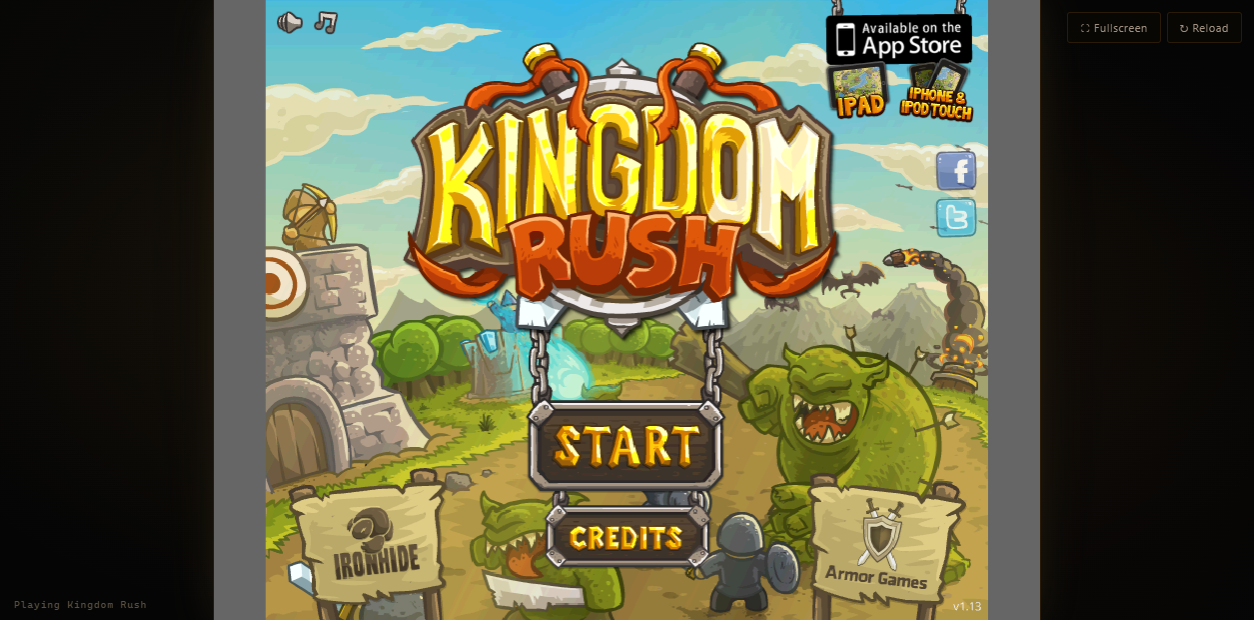
One thing to know before you start: Kingdom Rush is a 2011 Flash game by Ironhide Game Studio, and the version on this site is that original Flash build running through Ruffle. Everything described here is the original campaign experience, not the later sequels.
Controls
Kingdom Rush is played entirely with the mouse, or with touch on a tablet or phone. There is no click-and-drag army management and no keyboard requirement, though a few shortcuts exist.
Building a tower
Click a build spot. A tower selection panel appears. Pick the tower you want. The game asks you to confirm, usually by clicking the same spot again or a confirm button. Gold comes out of your total and the tower is built.
Upgrading or selling a tower
Click an existing tower. The panel shows its stats, its upgrade options, and a sell button. Upgrades are worth it when they solve the problem in front of you. Selling refunds 60% of everything you put into that tower, so a badly placed tower can be corrected without starting the stage over.
Moving the hero
Select your hero, then choose a point on the path to move them. A hero can fight or delay enemies at a useful chokepoint, so repositioning matters when a different lane needs help. Hero skills depend on the selected character and become available as that hero gains experience during a stage.
The two spells
Rain of Fire and Call Reinforcements are shared battlefield spells, separate from your chosen hero. Rain of Fire damages an area; Reinforcements places temporary soldiers who can block ground enemies. Watch their cooldown indicators and aim them where they buy the most time.
Tip
Keyboard shortcuts: 1 casts Rain of Fire, 2 casts Call Reinforcements, and Space or Esc cancels a pending action such as a half-placed tower or an aimed spell.
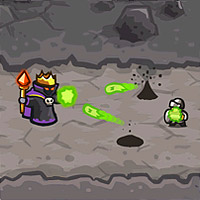 Original game artwork. A hero and a small enemy on the road. Use the game screen itself to check the current controls and wave information.
Your first stage, step by step
The first campaign stage is deliberately gentle. Follow this order and you will finish it without losing much.
- Read the map before you build. Watch where the enemies enter and where your gate is. Notice how many times the road passes near a build spot. Those are your spots.
- Build one tower at the first corner. The corner near where the enemies appear is the strongest position on an opening stage, because enemies bunch up there and walk slowly through it. Archer towers are the safe default choice: cheap, and effective against unarmored early enemies.
- Do not scatter. Put your second tower near the first one rather than at the far end of the road. Two towers covering the same stretch will hold far better than two towers covering different stretches, especially in the early waves.
- Keep your gold. Do not build the moment you can afford it. Spend only what you need to place a useful tower, and let the rest sit. Gold you did not spend is what pays for the upgrade that saves you later.
- Upgrade rather than add, once you have coverage. When two towers cover the road and you have spare gold, upgrading one of them is usually better than placing a third tower somewhere worse.
- Call waves early once you can handle them. The button to send the next wave early pays you bonus gold, which is a real income boost over a full stage. Do not use it while enemies are still on the road, and do not use it on a wave you are not sure about at the start.
- Move your hero to the threatened lane. Place them where they can fight under tower fire, then reposition when another route is about to leak.
- Finish the stage, then look at your lives. Three stars means you finished with 18 to 20 lives. Two stars is 6 to 17. One star is 1 to 5. Aim for three stars, but do not replay a stage over and over to get there before you understand it.
The four towers in plain language
There are exactly four base tower types. You unlock all four within the first few stages. Each one has a clear job and a clear weakness, and the weakness is the part to remember.
Archer Tower
Archers are the cheapest tower and the one you will build most of early on. They shoot arrows at single enemies for physical damage, they are fast to place, and they never waste a shot. They are your default answer to ordinary unarmored enemies, and their upgrade branches turn them into much bigger single-target damage later.
Bad at: anything armored, because armor cuts physical damage. Archers are also single-target, so they lose value against wide groups. A wave of twenty lightly armored enemies will overwhelm archers alone.
Barracks
Barracks do something no other tower does: they put soldiers on the road, and those soldiers physically block enemies. Blocked enemies stop moving. That turns a fast leak into a slow walk, which gives your other towers more time to shoot them. Barracks also deal physical damage as they fight.
Bad at: being a damage source on its own. Barracks hit softly compared to archers. They are a control and utility tower first, and they only shine when you have other damage covering the same stretch of road.
Mage Tower
Mages deal magic damage, and magic damage ignores armor. A fully armored enemy takes almost nothing from an archer tower and takes full damage from a mage. Mages also hit small groups of enemies rather than one, so they scale better than archers when enemies bunch up.
Bad at: magic-resistant enemies, which cut magic damage hard. If your mages appear to do nothing at all, you have almost certainly hit a magic-resistant enemy type, and the fix is physical damage.

Artillery
Artillery fires slow shells that explode over an area, hitting every enemy in the blast. It is poor against single enemies and against fast ones, because the shell takes time to land and a quick enemy can walk out of it. It is very strong against groups and against armored enemies, and it is the tower that saves you when a wave arrives as a crowd.
Bad at: single enemies, fast enemies, and anything that requires accuracy at range. If you place artillery on a straight open road where enemies walk in a thin line, it underperforms badly compared to archers.
Tip
On most stages, a mix of archers and mages covers the widest range of enemy types. Add barracks where you need enemies slowed down, and artillery where enemies arrive in crowds.
The five mistakes almost every beginner makes
1. Scattering towers across the map
Placing one tower on each side of the map feels thorough and plays badly. Half your damage is in the wrong place when the wave arrives, and each tower is too weak to matter on its own. Concentrate. Two towers on the same good stretch beat four towers spread thin.
2. Upgrading everything to level 2
New players often spread gold across all their towers so nothing feels neglected. That produces several weak towers instead of one strong one. Pick your best-positioned tower and upgrade it further, then decide again. Depth beats evenness.
3. Ignoring the armor and magic resistance rule
You build one type of damage and then wonder why a wave walks through untouched. Enemies have armor and magic resistance, and they decide what your damage does. If your damage stops working, the answer is usually a different damage type, not a bigger upgrade of the same one. See the enemies guide for the details.
4. Leaving the hero idle
A hero can move between threatened sections of the road and help hold enemies under tower fire. Move them before a lane collapses. Rain of Fire and Reinforcements are separate shared spells, so use those cooldowns where a dangerous cluster is forming.
5. Never selling a badly placed tower
A tower in the wrong place is a permanent tax on your gold. Selling refunds 60% of what you put in, which makes selling a genuinely good deal compared to leaving a useless tower for the rest of the stage. Do not panic-sell during a wave you are about to lose, but do sell the tower you know is wrong.
Warning
You cannot buy lives during a stage, and there is no undo button that refunds your gold. If a stage is going badly on your first attempt, restarting is often faster than trying to rescue it.
Progressing past the campaign
Stars and the six upgrade trees
Finishing a stage earns you between one and three stars based on lives remaining: 18 to 20 lives is three stars, 6 to 17 is two, and 1 to 5 is one. Stars are the game's permanent currency. You spend them in six upgrade trees covering Archers, Barracks, Mage, Artillery, Rain of Fire, and Call Reinforcements. These upgrades are permanent across every stage and every future run.
The important detail is that stars can be reset freely. If you have spread them thin or bought something you do not use, you can take the points back and spend them elsewhere without penalty. Do not treat your first purchases as permanent.
Unlocking heroes
Stars earned from stages pay for permanent upgrade trees. Hero availability depends on the edition of Kingdom Rush you are playing, so read the hero menu in your own build rather than assuming a star price. Some heroes are easier for a new player than others; the heroes guide focuses on how to use them once available.
Campaign, Heroic Challenge, Iron Challenge
There are three ways to play a stage. Campaign is the normal mode with your full 20 lives. Heroic Challenge gives you one life. Iron Challenge also gives you one life, but comes with a fixed, usually unflattering restriction on which towers and heroes you may use. The challenge modes unlock after you three-star a stage.
Difficulty is a separate setting: Casual, Normal, and Veteran. Normal is the intended difficulty for a first clear. Casual is a reasonable way to learn a stage you are stuck on. Veteran is much harder and is best saved for stages you already three-star on Normal.
Endless mode
Once you are comfortable with the campaign, endless modes are worth trying. Worth being precise about the history here: endless challenge modes were not part of the original 2011 Flash launch. They were added later as a content update, alongside the Winter Storm difficulty option, the Burning Torment campaign, and the Castle Blackburn campaign. The Flash build includes all of them, so they are available to you now.

If you only remember five things
If everything else fades, keep these. They cover most of what separates a stage that goes well from a stage that does not.
01 / Placement
Concentrate your towers
Two towers covering the same good stretch of road beat four towers scattered across the map. Fill spots early and keep them filled.
02 / Damage
Cover both damage types
Armor cuts physical damage. Magic resistance cuts magic damage. Mages beat armor, archers and artillery beat resistance. You need both.
03 / Economy
Call waves early
Sending the next wave before it is due pays bonus gold. Only do it when the road is clear and you can handle the wave comfortably.
04 / Hero
Move your hero constantly
Move the hero to the lane that needs help, and cast the shared battlefield spells when they can affect a dangerous group.
05 / Correction
Sell what is wrong
Selling refunds 60% of your investment. A wrongly placed tower kept for the whole stage costs far more than the 40% you lose.
That is enough to clear the campaign. Everything after this page is about playing it better, not about surviving your first stage.
Beginner questions
Can I play Kingdom Rush in the browser?
Yes. The version on this site is the original Flash build running through Ruffle, an emulator that runs Flash content in a browser tab. There is nothing to install and no account to create. The first load can take a few seconds while the emulator starts up.
How do I get more lives?
You cannot. Every stage starts with 20 lives and there is no way to buy more during a stage, and no way to restore them once they are gone. Lives are spent when enemies reach your gate, which means the goal is prevention rather than recovery: kill enemies before they walk the whole road.
What does armor versus magic resistance mean?
Armor reduces physical damage, which is what archers, barracks and artillery deal. Magic resistance reduces magic damage, which is what mages deal. Mage damage ignores armor entirely, so mages are the correct answer to armored enemies and a poor answer to magic-resistant ones. A defense with both damage types handles everything.
Should I sell my towers?
Yes, when a tower is clearly in the wrong place. Selling refunds 60% of everything you spent on that tower, so a bad tower you sell early costs you much less than a bad tower you keep. The exception is panic: do not sell during a wave you are barely holding, because you will have less damage at exactly the wrong moment.
How do I unlock heroes?
Hero availability varies by release. Open the hero menu in the build you are playing to see which characters are ready and what unlocks the rest. Campaign stars are used for permanent tower and spell upgrades.
What difficulty should I pick?
Normal. It is the intended difficulty for a first clear, and it is the right baseline for earning three stars. If a stage is genuinely beating you, Casual is a legitimate way to learn the layout before trying Normal again. Veteran is much harder and is worth saving for stages you have already mastered.
Why do my mages do nothing to that enemy?
That enemy is magic-resistant, which cuts magic damage sharply. Mage damage ignores armor, but it does not ignore magic resistance, so the two protections work in opposite directions. The fix is to answer magic-resistant enemies with physical damage: archers, barracks, or artillery placed near where they walk.
Is this the original game or a sequel?
This guide covers the original Kingdom Rush by Ironhide Game Studio, released in 2011 and published by Armor Games. The browser version on this site is that original Flash build. Later sequels are separate games with different systems, so nothing here transfers to them.